Tech List - the labour of love
When I started The List, it was a labour of love. A passion project, borne out or a burning desire to develop an English-speaking ‘voice for Trondheim’.
This moniker quickly became a self-serving truism. Not only was it a voice in the sense we were giving the international community an outlet, but we were also speaking to the newcomers, as the voice of Trondheim. Soon, we also began speaking outwards, about the little city we call home.
Originally, we were focussed on listings (hence the name), writing about everything which was going on. The pain point of the company’s origin was that we, as newcomers to the region, often found it hard to keep track of the clique-y social scene. Once we had carved out a little piece of the public’s awareness, we moved into other spheres, curating and delivering other print products.
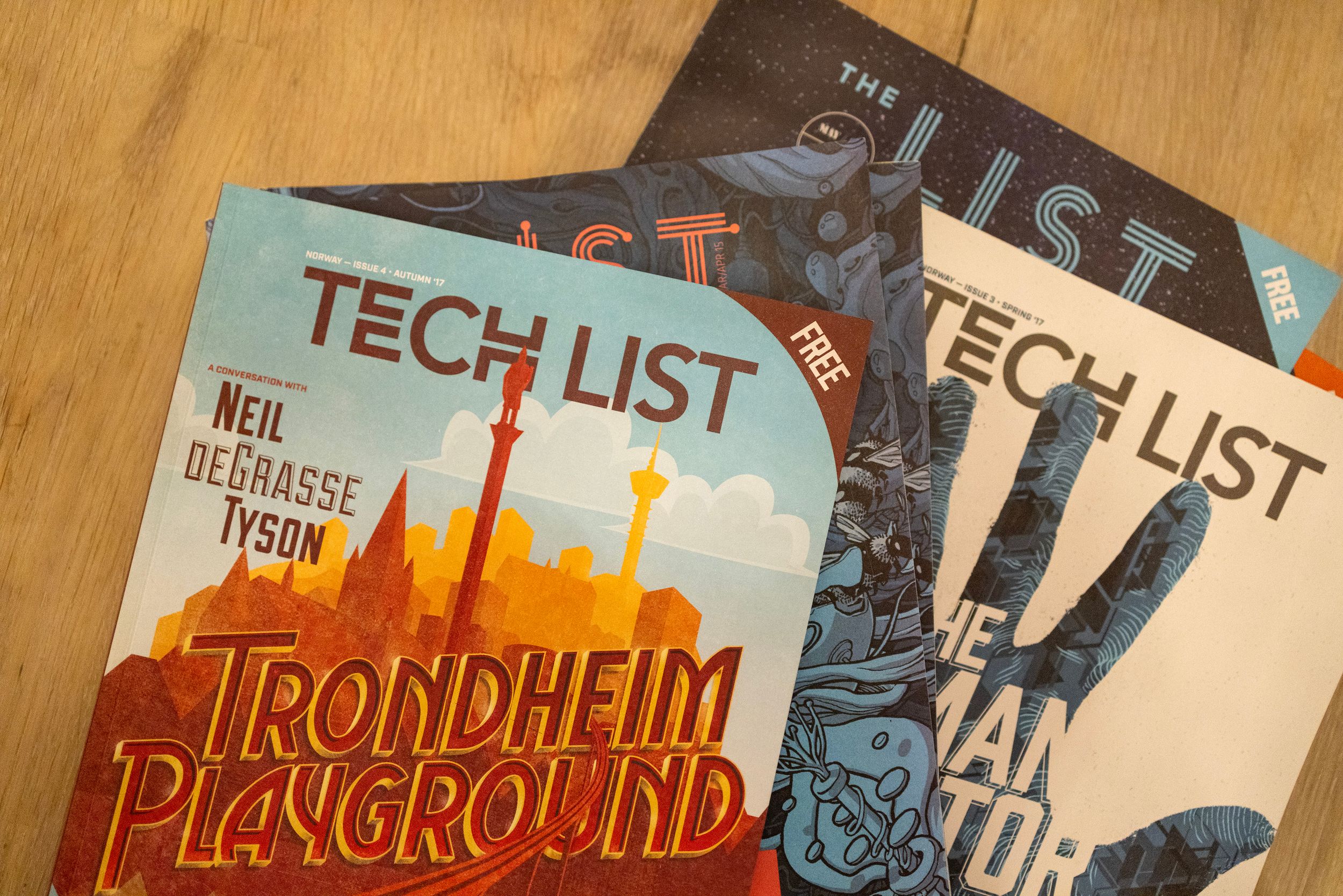
Perhaps the most significant of these was Tech List, a magazine which we created in collaboration with NTNU and Technoport, to promote and discuss the achievements of the local technology bubble. I was particularly proud of the front pages, including the Trondheim Playground for issue 4 (above), which was created in collaboration with the illustration at Høyskolen Kristiania.
It is a strange thing to look back on one’s musing about technology, as it is predominately a forward thinking pursuit. The content very rarely ages well. This one article I wrote about trust networks still holds up in today’s world. Here I reproduce it in full (first published in Spring 2017, Tech List issue 3):
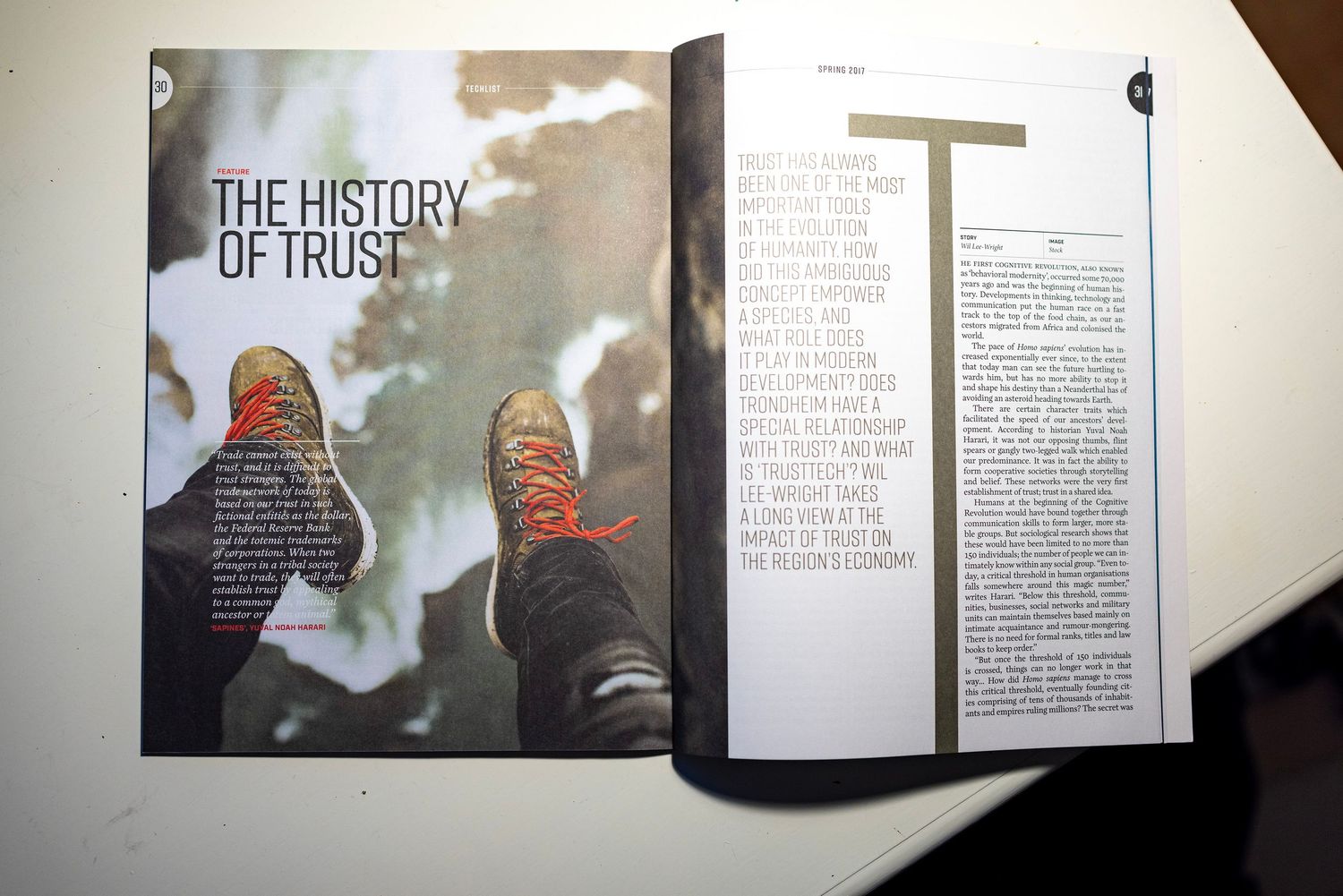
First published spring 2017, Tech List issue 3
The history of trust
Trust has always been one of the most important tools in the evolution of humanity. How did this ambiguous concept empower a species, and what role does it play in modern development? Does Trondheim have a special relationship with trust? And what is ‘TrustTech’? Wil Lee-Wright takes a long view at the impact of trust on the region’s economy.
“Trade cannot exist without trust, and it is difficult to trust strangers. The global trade network of today is based on our trust in such fictional entities as the dollar, the Federal Reserve Bank and the totemic trademarks of corporations. When two strangers in a tribal society want to trade, they will often establish trust by appealing to a common god, mythical ancestor or totem animal.”
‘Sapines’, Yuval Noah Harari
The first cognitive revolution, also known as ‘behavioural modernity’, occurred some 70,000 years ago and was the beginning of human history. Developments in thinking, technology and communication put the human race on a fast track to the top of the food chain, as our ancestors migrated from Africa and colonised the world.
The pace of Homo sapiens’ evolution has increased exponentially ever since, to the extent that today people can see the future hurtling towards them, but have no more ability to stop it and shape their destiny than a Neanderthal has of avoiding an asteroid heading towards Earth.
There are certain character traits which facilitated the speed of our ancestors’ development. According to historian Yuval Noah Harari, it was not our opposing thumbs, flint spears or gangly two-legged walk which enabled our predominance. It was in fact the ability to form cooperative societies through storytelling and belief. These networks represented the very first establishment of trust; trust in a shared idea.
Humans at the beginning of the Cognitive Revolution would have bound together through communication skills to form larger, more stable groups. But sociological research shows that these would have been limited to no more than 150 individuals; the number of people we can intimately know within any social group. “Even today, a critical threshold in human organisations falls somewhere around this magic number,” writes Harari. “Below this threshold, communities, businesses, social networks and military units can maintain themselves based mainly on intimate acquaintance and rumour-mongering. There is no need for formal ranks, titles and law books to keep order.”
“But once the threshold of 150 individuals is crossed, things can no longer work in that way… How did Homo sapiens manage to cross this critical threshold, eventually founding cities comprising of tens of thousands of inhabitants and empires ruling millions? The secret was probably the appearance of fiction. Large numbers of strangers can cooperate successfully by believing in common myths,” writes Harari in his book Sapiens.
The basic foundations of modern society, and eventually a globalised economy, can be said to be based on a series of interminable networks of trust, either in fabricated concepts or manmade systems. Early tradesmen put faith in their trade partners, Vikings fought for one another because they trusted wholeheartedly in the lure of Valhalla, conquistadors took to the high seas because they believed in glory, and modern businesspeople take the existence of nation states, the financial system, laws, human rights and countless other human institutions, as gospel. Yes, these are largely positive human developments which enable millions of people to cooperate, but they are fabrics of collective imagination nonetheless, and the parameters of these beliefs are always in flux.
Trusting Trondheim
Modern Trondheim offers a particular set of socioeconomic circumstances in which trusting networks can flourish. There seems to be near universal acceptance, from residents and visitors alike, that business and community relations are more trust-based than in any other Norwegian city. This trust is evidenced by friendly relations between representatives of competing interests, responsibility sharing between employees, and the ease of doing business person-to-person.
A consortium of interested parties in the city have now started developing the concept of ‘TrustTech’, which seeks to understand the circumstances and garner benefit for the region’s development. “What we are seeing is that in Trondheim it is easier to initiative a person-to-person business deal than in other cities,” says Save Asmerik, Department Director at Webstep and one of the founders of the TrustTech community. “I don’t have to know the person on the other side of the table. In Bergen for example, there is a stronger tradition of having to know someone in order to do business together. Trondheim is a small town and if I don’t know you we probably at least know the some of the same people.”
“We are finding it is extremely easy to collaborate in Trondheim,” continues Save, whose also leader of the programme committee for the Trondheim Developer Conference (TDC), a non-profit collaboration between developers and digital designers. “TDC is an excellent example of how competing companies are able to come together to create (an event), trusting each other in the process. Participation in collaborative events from the developer community is a much higher percent than in Olso, for example, where there are ten times the amount of developers but only three times as many conference attendees. No one is reaping the benefits over the others.”
“When you combine the size with the tradition of dugnad (unpaid, orchestrated community work), you get the perfect storm. From football teams to skiing groups to the collaboration of Trondheim Playground (trondheimplayground.no). I don’t know where the trust comes from, maybe it is because there are a lot of small businesses in Trondheim, so there are less internal-only meetings, so we are compelled to spend more time collaborating with other businesses.”
An enviable reputation
Trondheim does indeed boast some enviable numbers. According to the Norwegian Statistics Bureaux (SSB), Trondheim has the lowest levels of income inequality in all Norwegian cities (as reported by NRK, 2014). Furthermore, and perhaps even more compelling, is the fact that Trondheim has the lowest difference in life expectancy between groups with the lowest and groups with the highest levels of education: less than one year difference between the two groups (NTNU). In Oslo the difference is nine years and in London the gap between the life expectancy of the rich and poor is 25 years (Independent, 2014).
Financial security and safety are trust’s natural bedfellows. Combined these with Trondheim’s population of fewer than 200,000 city residents, its high levels of participation and its relative geographical isolation, and you have a self-serving economy where it is rarely in an individual’s best interests to screw anyone else over. “The world is small, especially in Trondheim,” Save repeats. “In Norway we have a saying ‘the only thing you own for ever is a bad reputation’.”
Security v Agility
Trusting economies breed confident, autonomous, self-motivated workers. They also give businesses the opportunity to work with less red tape and therefore make up for what they lack in size with speed. Many industries around the world have sought to adapt to the pace of change by turning to methods of agile development. Can Trondheim utilise its trusting economy and bring in investment by becoming a market leader in agile development?
Agile development is particularly applicable in the area of software development, an industry in which the Nordics already offer quality for low cost. Whereas traditional software development is carried out by large teams working in a hierarchy, hindered by countless bottlenecks of quality control and assurance, agile software development is all about collaborative, cross-functional teams, taking responsibility for bitesized pieces of the whole. It allows for products and services which are subject to high levels of change, to adapt and identify pitfalls rapidly. Each cell is responsible for its own functionality, so long as it fits the wider platform. If you are from a trust-based culture your employees are used to this kind of autonomy and more suited to working independently.
Eirik Backer, Frontend Developer at NRK in Oslo, was brought up in Trondheim and only recognised Trondheim’s openness once he moved away: “I must admit I didn't really think about the openness found in the region when living in Trondheim. The concept of ‘TrustTech’, was kind of just how I was raised. My first job was at Klipp og Lim at the age of 15, and the first project I did was the website for the Trondheim Symphony Orchestra. Looking back, they gave me tremendous responsibility.”
Proficiency in agile development will have positive reinforcement for many industries, though adoption may prove challenging for others. Trondheim has a strong environment in financial technologies (FinTech), and a lot of Norwegian credit card and insurance business comes out of the city. Development of new payment systems requires a high level of security and so agility is often scrutinised by users for whom trust is paramount. Save Asmervik questions why this is so: “Any qualified actor can ask for your permission to be your banking interface. So, the question becomes - who do you trust? Sparebank1? Rema1000? Google?”
There is always a transaction of trust in any relationship, trade or system and herein lies the challenge. Users trust in the bank because they are the bank, and because they traditionally have a monopoly on financial security systems. As these systems become more readily available, and the borders between virtual and physical services blur, users in a trusting economy such as Trondheim may choose to place their trust in a nonconventional business or individual.
Ultimately, functionality must transcend Trondheim’s borders. In order for its exports to be adopted outside of this trusting bubble, conventional services and standards are still predominant. Do I trust my Rema1000 banking interface to work as well as my Sparebank1 card? And does a service which is developed in a trusting economy have security robust enough to survive in a more cutthroat environment? Trust, and agility by the same measure, are based on the principle that small elements can fail, pivot and restart, without affecting the greater picture. We may entrust a stranger to park our car because, should it be scratched, it is still just a car at the end of the day. We probably would not trust that same stranger to walk our kids to school, at least not without some fairly rigorous checks. Industry is fast with the same inability to scale up the trust economy. Failing fast, as one commentator put it, is not desirable when building a nuclear reactor, “unless you are an idiot”.
“When you compare the culture of Trondheim and Oslo, it is not so much a question of competition between companies, but rather a difference in the micro-dynamics between people,” comments Eirik Backer. “Trondheim can sometimes vary in quality and focus on competence, whereas the communities in Oslo tend to be more up-to-date, specialized and high quality. The standard in Oslo is good, but it also raises the bar to become part of the community, and even silences initiatives.”
The World’s Friendliest Town
Marianne Danielsen, Bureau Leader and Co-Founder of communications specialists Engasjert Byrå, moved back to Trondheim in 2007 after seven years in Oslo. She is a self-confessed project junkie: always with several activities on the go. With projects including the book Vennligheten Kommer: Trondheim, Verdens Vennligste By (Friendliness Comes: Trondheim, the World’s Friendliest Town) and the podcast Fine Folk (Good People), Marianne is well placed to speak about the potential benefits of a trusting economy. She contends that openness can sometimes be perceived as naivety:
“There is a tendency to keep giving work to your old contacts, even when they are not giving you anything new,” discusses Marianne. “In the last ten years I have seen changes to do with trust and openness in Trondheim - we have become more curious about each other.”
“That is a good thing, but sometimes it seems like there needs to be a burning platform, an urgency to get going (among business) in Trondheim. And that is not good for innovation. For example, there is not a lot of small talk in meetings in Oslo, whereas the pace here is slower. You use 30-40 minutes to discuss other stuff before you get started. When I came back this was crazy to me, but then after a while I became part of it!”
In 2012 Marianne launched Gi Bort Dagen (Give away a Day) in Trondheim, to encourage individuals and companies to give up 29th February during the leap year, to someone who was in need of their help or skills. The concept was based on establishing trust, a resource in abundance in Trondheim, and it went national following local success.
Can such collaborative success be applicable in technology development as well as humanities? Well, take the Samsung Galaxy S7 Edge (Exynos model); a phone whose touchscreen technology was developed by Atmel, whose 3d tech is delivered by Falanx, whose foundations lie in Global System for Mobile communications (GSM), and on which the world’s then most popular app, Wordfeud, was developed by Haakon Berteheussen. All companies based in Trondheim.
Whether this success is creditable to ‘TrustTech’ is debatable. The proficiency is clearly there, so is the willingness to collaborate. But there is no technology directly attached, in the same way as payment solutions exist in FinTech, and virtual reality headsets are utilised in health (MedTech). Perhaps a better terminology would be the ‘trusting economy’; a concept and a set of principles which are prevalent throughout all sectors in the region. This could be a big drive for investors considering doing business here.
The need is apparent too: with global dissatisfaction in the establishment at an all-time low, and technological advancements outstripping our ability to adapt through conventional means. ‘Fake news’ just got a president elected. The banks behind the financial crash bullied their way out of prosecution. Global industry is shifting the goalposts on environmental targets daily. Trust is suddenly a resource at a premium.